The Leader’s Mindset: Default Mode, Distraction, and the Courage to Sit Still
Biggest leadership challenge isn’t time—it’s attention.

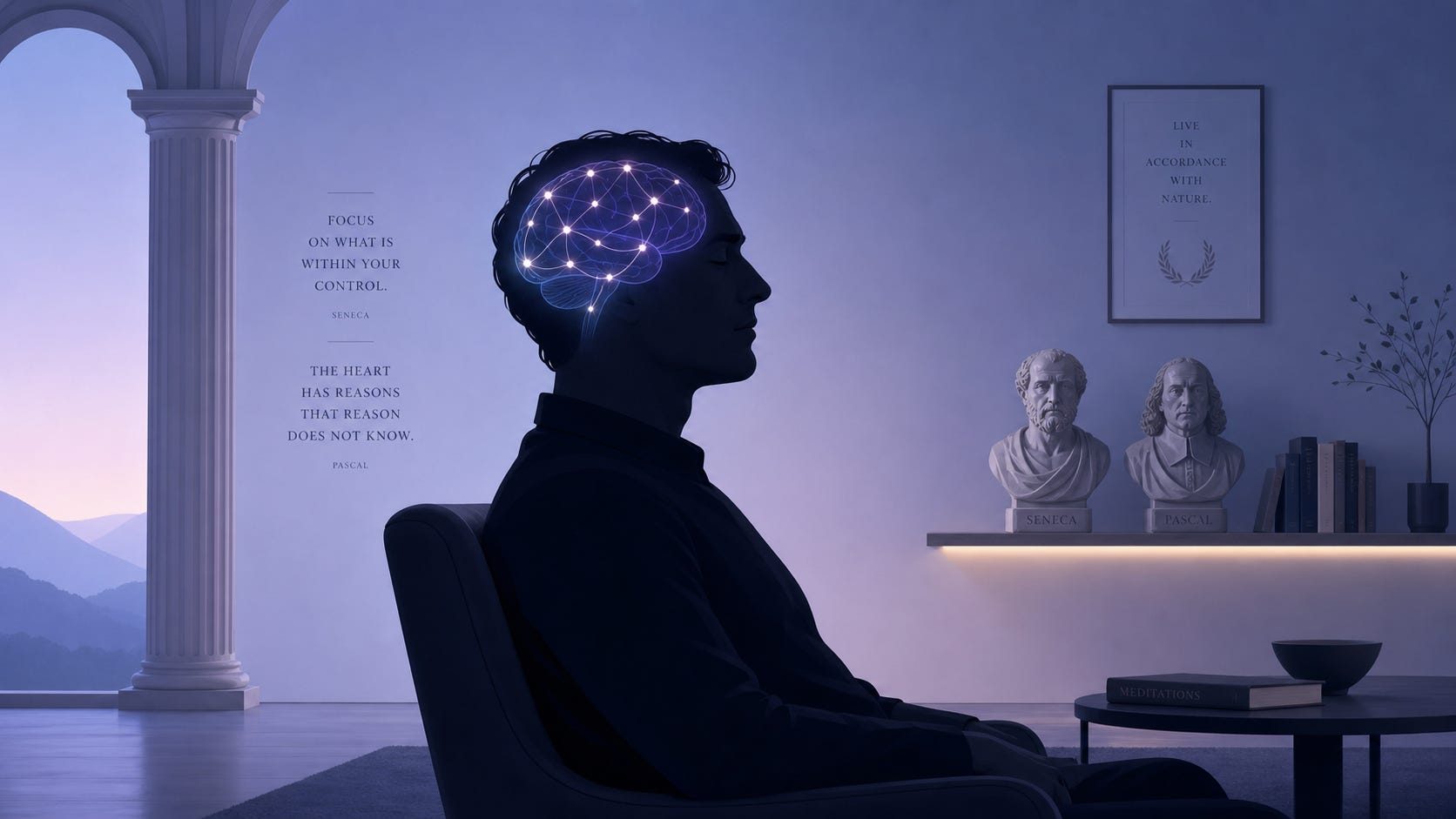
The Leader’s Mindset: Default Mode, Distraction, and the Courage to Sit Still
“All of humanity’s problems stem from man’s inability to sit quietly in a room alone.” Blaise Pascal wrote that centuries ago, long before we could watch a wandering mind light up on a brain scan. Seneca, even earlier, warned that a distracted life is a wasted one and urged us to strip away “superfluous” thoughts and noise if we want to live wisely.
Today, neuroscience gives those ancient insights a new language: the Default Mode Network (DMN), the brain’s background network that comes online when we’re not locked onto a specific external task. As a school and systems leader, once I understood how the DMN relates to mind‑wandering, attention, and learning, I stopped seeing distraction as a purely moral or motivational problem. Instead, I began treating attention as something we can design for, train, and protect.
What the Default Mode Network Is Doing in the Background
The Default Mode Network is a set of brain regions that become more active when we are at rest—when we’re daydreaming, reflecting on ourselves, thinking about other people, remembering the past, or imagining the future. When we shift into demanding external tasks—solving a problem, reading closely, engaging in intense conversation—other attention and control networks become more active while the DMN typically quiets down.
Because of that see‑saw relationship, researchers often link DMN activity with mind‑wandering and “task‑unrelated” thought. When the DMN stays too active while we’re supposed to be focused, attention tends to drift; performance on the task in front of us becomes more variable and error‑prone. In other words: the brain’s default is not always aligned with our goals.
Mind‑Wandering, Learning, and the Myth of “Just Try Harder”
Mind‑wandering is not laziness; it is how the brain naturally operates. Neuroscience describes it as “perceptual decoupling”—our attention temporarily unhooks from incoming sensory information, which is why we miss a paragraph we just read or lose the thread of a meeting even when we care about it.
This has huge implications for learning. When students or adults are trying to do complex work, persistent DMN activity shows up as off‑task thinking, missed instructions, and inconsistent performance—even with high motivation. At the same time, that very same network underpins memory, self‑reflection, social understanding, and planning—the parts of learning where we connect new information to who we are and where we’re going. The goal, then, is not to “turn off” the DMN, but to help people time and channel it.
Seneca: An Early Researcher of Attention
Seneca never saw a brain image, but he observed the mind with the same curiosity we now bring to MRI studies. He noticed how easily we scatter ourselves on trivial pursuits and warned that a life full of distractions leads to agitation, outrage, and wasted time.
His advice sounds surprisingly modern: remove unnecessary distractions, filter superfluous thoughts, and choose deliberately what deserves your attention. When we do this, he argues, we move from being yanked around by every new stimulus to acting with calm and intention—a behavioral description that maps neatly onto better coordination between the DMN and attention networks. In a sense, Seneca was running “field research” on the same attentional dynamics neuroscientists are now quantifying.
Pascal: Our Discomfort With Unstructured Mental Time
Pascal’s famous line about sitting quietly in a room alone is, in modern terms, a diagnosis of our discomfort with unstructured DMN time. To sit quietly is to stop feeding the brain with constant external input and face whatever arises: memories, worries, hopes, regrets.
Neuroscience confirms that the DMN is highly active during wakeful rest, when we are not engaged in a specific task or sensory stream. For many of us, that state quickly becomes uncomfortable, so we fill the silence with noise, apps, and scrolls—the digital equivalents of the banquets and forum gossip Seneca wrote about. Pascal’s observation feels more relevant than ever: we will do almost anything to avoid being alone with our own unfiltered thoughts.
The Leader’s Mindset: Attention as a System‑Level Asset
In leadership circles, we often say time is our scarcest resource. I’ve come to believe that attention is even scarcer. Research shows that when the DMN does not appropriately quiet during demanding tasks, we see more lapses in attention and more variability in performance. The Stoics would say something similar in their own language: when we do not govern our attention, we drift into busyness, outrage, and trivial pursuits.
A Leader’s Mindset informed by both fields treats attention as a strategic asset to be protected:
For individuals: How much of my day is spent in environments that almost guarantee DMN‑driven distraction—constant pings, open tabs, overlapping meetings?
For teams: Where are we expecting deep work but offering none of the conditions that help the brain focus?
For students: Where in the school day is there space not just for focused effort, but also for the reflective, DMN‑heavy processing that consolidates learning?
Amishi Jha and Training a Peak Mind
If Seneca and Pascal are early “researchers” of attention from the inside out, Amishi Jha represents the lab‑based, twenty‑first‑century counterpart. In Peak Mind, she draws on her work as a neuroscientist to show that the ability to be present and focused under pressure is not a fixed trait but a trainable capacity. She writes for people whose attention is under constant assault—soldiers, first responders, athletes, leaders—and offers science‑based ways to strengthen that capacity without escaping from real‑world demands.
Endorsements of the book describe it as “a brilliant guide for training our attention with mindful awareness and maximizing our human potential,” and “an invaluable guidebook for leaders to gain and sustain high performance over time.” For me, that’s where Jha’s work slots into this DMN‑Stoic picture: the DMN helps explain why our minds drift, Seneca and Pascal remind us that distraction is an old human problem, and Jha hands us practical drills for training attention in the middle of modern life—not in a monastery, but in the mess.
Designing for Distraction‑Free Learning
Once we accept that the DMN will do what it does, the question shifts from “How do I stop distraction?” to “How do I design environments that respect how attention actually works?” For me, that has translated into a few practical design commitments:
Protect real focus blocks.
Research shows that performance declines when the DMN remains highly active during demanding tasks. In practice, that means building protected blocks of time—no notifications, minimized noise, clear single‑task expectations—for teams and students. We should not ask for deep work in conditions that make deep work nearly impossible.Normalize mind‑wandering—and teach the “return.”
Studies describe mind‑wandering as a normal, frequent state, not a defect. Instead of shaming distraction, we can teach a simple skill: notice when attention has drifted, and gently bring it back. That’s mindfulness in plain language and a habit we can embed in classrooms, meetings, and our own routines.Schedule deliberate DMN time.
The DMN supports memory, self‑referential thinking, and future planning—all essential for meaning‑making and leadership. We can build short, device‑free moments into the day for reflection, journaling, or quiet thinking so the brain can integrate what it has taken in. That’s Pascal’s “room alone,” turned into a calendar block.Redesign systems, not just tell people to “try harder.”
Work on attention challenges, including inattentive ADHD, links DMN dynamics to trouble with sustained focus. Instead of labeling people as unmotivated, we can simplify workflows, reduce competing demands, and clarify priorities so that attention has somewhere coherent to land.
Stoic Practices as Everyday Brain Training
Viewed through a DMN lens, many Stoic practices look like structured ways of engaging the brain’s default mode on purpose. Seneca’s evening review—looking back on the day and asking where time was used well or poorly—is a guided use of memory and self‑reflection. Pascal’s challenge to sit quietly without distraction can be seen as training our tolerance for unstructured internal experience.
For modern leaders, that might look like a brief daily journal, a few minutes of silent reflection before key decisions, or a device‑free commute. These are small, repeatable rituals that blend Stoic wisdom with what we now know about brain networks: they strengthen our ability to move between focused and reflective modes without being hijacked by either.
Leading by Owning Our Own Attention
All of this leads me back to a simple leadership truth: we cannot steward the attention of a classroom, a school, or a system better than we steward our own. The DMN is always there, ready to spin stories, jump timelines, or pull us away from the present moment. Seneca and Pascal remind us that distraction isn’t new; it just has brighter screens now. Dr. Amishi Jha shows that attention is trainable, even in the middle of chaos.
A Leader’s Mindset in this moment means treating attention the way we treat budgets, data, and strategy—with intention, constraints, and regular review. It means designing conditions for deep focus and deep reflection, not accidentally rewarding constant distraction. And it means, every so often, accepting Pascal’s old challenge in a very modern way: closing the laptop, putting the phone in another room, and noticing what happens when we finally let ourselves sit quietly—and lead—from there.